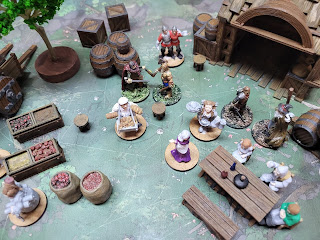
Chapter 16 - The Birth of Bramblehold - The story of Lucia (Elf of Starfen), and Peter Anderton

The smoke lay low and bitter in Peter’s throat, a dull
blanket of heat pressing against his brow as he hacked through bramble and
pine. Ash fell like snow. Behind him, the firebreak gaped open—a strip of raw
earth meant to hold the flame. It wouldn’t be enough.
That was when he saw her.
A silhouette within the smoke, graceful but real—more
dream than person. She moved through the haze like something summoned from an
old grove song: tall, with soot-streaked cheeks, her long braid matted with
ash, guiding panicked beasts through the gaps like a ghostly shepherd. A fox
clung to her side. A hare bounded between her steps. Even the fire seemed to
curl away from her presence.
“Hey! You can’t go in there!” Peter shouted, waving his
billhook.
She looked back once. No fear in her face. Just quiet
certainty.
“You put your firebreaks wrong,” she called back, then
vanished between the trees.
Later, he found her again at dusk, kneeling beside a
scorched riverbed. A fawn lay curled beside her, its leg bound with bark
splints. Her fingers moved gently, binding and blessing. She didn’t look up as
he approached.
Peter scratched the back of his head. “You’ve got nerve,
saying that. I been managing this land for six years.”
She stood slowly, eyes narrowing. “You’ve been surviving
it. Not listening to it.”
That night he slept poorly. Her words clung like burrs.
Over Months: From Antagonism to Kinship
Their meetings became inevitable.
In the thickets tracking a shadow-stag, they argued over
signs and spoor. Foraging in opposite corners of the same glade, they'd pretend
the other didn’t exist—until they started swapping techniques without words.
She left him a bundle of firefern moss by his snares one morning. He left her a
perfectly smoked trout wrapped in birch bark the next.
He taught her how to ferment root beer in clay jugs. She
showed him how to walk across leaf-litter without a single crunch. They began
speaking in gestures, shared glances, and half-smirks.
One twilight, she asked him:
“You miss them? The ones who raised you?”
Peter stared into their campfire. “Every day. But the
forest doesn’t care. It just keeps growing.”
Lucia poked at the coals. “That’s not unkind. That’s its
mercy.”
When she finally told him her sister’s name—Elyariel—her
voice cracked like frost underfoot. He said nothing, only reached out to hold
her hand across the embers.
The wind carried no words that night. But something
deeper than language settled between them.
“Rooted in the Wild” - They began building in early
autumn, when the forest still held its green breath before the golden turning.
Peter selected the site: a gentle slope beneath a moss-veiled bluff where water
flowed under the earth, never freezing even in winter. “High enough to watch
the trail. Sheltered enough not to catch the wind’s wrath,” he explained,
running a calloused hand over a granite outcrop. “And see there? Fox tracks.
They know good ground.”
Lucia said nothing at first. She knelt, brushing away
leaf-litter with her fingers. Beneath it, tiny shoots of starleaf moss grew in
a spiral.
“This land remembers peace,” she murmured. “It will
welcome us.”
Peter looked at her sidelong. “You always speak like
that?”
She smiled faintly. “Only when I mean it.”
Peter's hands bore the marks of a thousand small cuts and
old burns, thick-fingered but deft. He carved stone and timber with a quiet
intensity, rarely wasting a movement. He could lift a beam on his own but
always paused when Lucia offered to steady it.
Lucia’s touch was more deliberate. She carved supporting
beams with curling sigils and whorls from old elf-script, muttering soft
blessings in her mother tongue as she worked. She bent live branches into
frames and wove willow into corners that swayed but never broke.
At first, they bickered over almost everything.
“That wall’s too thick—we’ll waste warmth.”
“No such thing. A wind from the north’ll peel you open if
you let it.”
“And the windows—you put them to face the west?”
“That’s where storms come from. I want to see them
coming.”
“You’ll blind yourself with afternoon sun!”
But then came the evening they set the hearthstone.
Lucia pressed the smooth moonseed rock into place with
both hands, lips moving in a silent invocation. Peter, kneeling beside her,
added three charred coals from his old ranger’s fire pit and sealed the base
with ash and packed clay.
When they finished, they sat back together, covered in
dust and soot, and watched the first firelight dance between the stones.
“It’ll hold,” Peter said, voice low.
Lucia nodded. “It already does.”
“Stonereach Bones”
Peter began the build by clearing a natural rock shelf beneath a moss-covered
bluff, ensuring the cottage had a dry, stable base. He used river stone and
scavenged mountain slate from old quarry trails to construct thick, frost-proof
walls. The floor was tamped earth overlaid with flat river stones; their smooth
surfaces cool in summer and easy to warm with a fire in winter. Lucia inlaid
spirals of carved wood and old elven sigils between stones—blessings of hearth,
home, and warding.
“Heart of the
Root” The central room is a combined kitchen and living space, dominated by a
broad stone hearth that Peter built by hand. Embedded in the centre of the
stone hearth is a pale grey Riverstone streaked with silver. This is a Moonseed
Hearthstone, a gift from Lucia’s grandmother, passed down the Starfen line.
Once per week, when lit by moonlight, the fire glows silver-blue and repels
spectral creatures and dark magic. It grants +1 Willpower to all inside the
cottage at night. If a wounded creature sleeps before it, they recover +1
additional wound. The chimney flue winds upward through the roof like the trunk
of a gnarled tree, lined in firebrick and crowned with a copper vent. Lucia
crafted mantle carvings from driftwood: deer, owls, vines, and stars. Herbs dry
from ceiling beams; pans hang from hooks. A heavy oak table sits near the
hearth, worn smooth by shared meals and map-scrawling. There are two
chairs—each carved to match its user: hers sleek and long-limbed, his broad and
rugged. A low shelf holds scrolls, tools, a reed flute, and Lucia’s journals. A
worn rug, made from old cloaks and stitched hides, softens the stone floor.
Lucia carefully embedded ceramic tiles carved with the Runes of Lethariel into
the walls and floor joists during construction. These are protective sigils,
attuned to natural flows of life-force and the seasonal cycle. They prevent
decay, mildew, or vermin infestation within the structure. The house is always
temperate—cool in summer, warm in winter, unless overpowered by direct magic.
If a Chaos creature enters the home, the tiles subtly hum with warning.
The Green Alcove – “Elven Nook” just off the main room is a small south-facing
alcove, walled partially in living willow branches woven into a trellis. Lucia
planted it herself, encouraging the wood to grow into arched window shapes over
time. The leaves murmur softly, even when there is no wind and alerts Lucia to
intruders (humanoid or monstrous) within 200 yards. They allow Lucia or Peter
to speak one sentence to each other through the leaves, even if they are
separated by dungeon, wood, or storm. Can be used once per day. This room is her
retreat—a place of sunlight, scrolls, and potions. Here she dries herbs,
prepares healing salves, and whispers to potted forest plants. A tree-root
writing desk curls out of one corner, and a crystal hung in the window casts
rainbows across the ceiling at dawn. A hanging lantern above their shared table
emits gentle firelight without fuel. A flicker of ember-spirit lives within it,
drawn from an ancient pact in Starfen Grove. Casts soft, non-burning light that
repels minor spirits and insects. If both Peter and Lucia are present and
concentrate, it can illuminate hidden writings, magical traces, or reveal
illusions within the room once per day. On the eastern wall of the cottage,
Lucia etched a map of the surrounding region into the wood using silver-dust ink
and sap from a starroot tree. With time, it has become semi-sentient. The map
updates itself slowly with natural changes in terrain, monster migrations, or
corrupted zones. Once per week, it can reveal a hidden trail or passage they
were previously unaware of. At dusk, the ink glows faintly, guiding with stars.
The Sleeping Loft – “Feather and Hide” Above the hearth
room, accessible by a ladder carved from a wind-fallen pine, is a small
sleeping loft. The bed is raised on a wooden platform stuffed with straw and
lined with rabbit furs and feather pillows. Hung in a wooden box near the door
is a long, striped feather bound with silver thread: the feather of Vorynn, an
ancient owl spirit revered by wilderness elves. Once per adventure, it can be
activated to allow one inhabitant to reroll any failed Awareness, Ambush, or
Tracking check. At night, it may cast Silent Watch: an invisible owl spirit
that alerts them to danger during rest. Once per adventure, it can be activated
to allow one inhabitant to reroll any failed Awareness, Ambush, or Tracking
check. At night, it may cast Silent Watch: an invisible owl spirit that alerts
them to danger during rest. Carved into the overhead beam above their sleeping
loft is a Lull Rune—a stylized spiral designed to draw nightmares away. Lucia
crafted it from the bone of a dusk-elk, and Peter sealed it with sweat and ash.
It grants calm, uninterrupted rest to both even after dungeon delves or psychic
attacks. If one has a prophetic dream, the rune will preserve it clearly until
written down. Windows on both ends allow cross-breezes and a view of the stars.
Lucia often sleeps lightly, her bow within reach. Peter sleeps like a stone but
always keeps his knife under the pillow.
“Tools and Twine”
A side extension built by Peter from scavenged barn wood forms his workroom and
storage space. Here he crafts traps, sharpens tools, and hangs meat to dry.
Peter once discovered a cache of ancient dwarven-elven collaboration artifacts
buried beneath a tree stump—among them, six black-steel nails etched with
binding runes. Lucia recognized them as Harluin's Binding Nails, relics used in
ancient war lodges. Used in the roof beams, they bind the structure to the
leyline beneath Bramblehold, making it immune to mundane fire or earthquake. If
the house is ever attacked, they can summon a Barkshield, a magical wooden wall
that seals all doors and windows for 1D6 turns once per adventure. Hooks line
the ceiling for netting and cord. Shelves are filled with nails, binding
straps, snares, fletching gear, and preserved roots. There’s a small forge
corner with bellows, anvil stone, and charcoal storage. Lucia added a
weatherproof cabinet where they store maps and survival logs.
“Watcher’s Step” the
front porch is covered, with rough-hewn beams and bark-on planks for a natural
look. Lucia carved a small fox totem into the doorpost; Peter nailed a chime of
bones and feathers above it—meant to ward off goblins or worse. A stone bench
sits beside the door, always in use: for lacing boots, drying socks, or
watching the forest line in silence. The porch overlooks their smallholding—a
series of vegetable plots, root cellars, and a fenced goat pen.
“The Root Cellar” beneath
the cottage, accessed via a trapdoor in the hearth room, lies a cool stone root
cellar. Lucia uses it to store mushrooms, preserved fruit, and old elven wines.
Peter keeps smoked meats, traps, and pickled vegetables in stone jars. There’s
a small cache of weapons hidden behind a false wall. If the cottage is ever
attacked, they could hold out here for days. h. Atmosphere Their home smells of
firewood, dried herbs, and warm soil. It is filled with handmade tools, natural
light, quiet music, and the quiet warmth of a hard-earned life. There are no
locks on the doors—only hidden snares in the undergrowth, and the sense that
the forest itself watches over the place. Over time, the cottage has become
attuned to its builders. It subtly recognizes their presence and will resist
intrusion by outsiders through small accidents: hinges that stick, crows that
warn, paths that twist. The home has developed what has become known as the
Bramblehold Spirit. Some even say Bramblehold has a soul now—one woven from love,
bark, starfire, and sweat.
“They’ll grow fast,” she said, brushing earth from her
palms. “And they’ll sing when something disturbs the stillness.”
Peter crossed his arms. “You say that like it’s normal.”
She gave a small smile. “It is. If you’re listening.”
And sure enough, weeks later, when Peter stepped too
close with an armful of kindling, the branches rustled in warning though the
air was still.
He grunted. “Guess they don’t like strangers.”
Lucia tilted her head. “They’ll get used to you.”
Peter laid out the smallholding with the precision of a
trapper’s snare: rows of turnips, parsnips, onion, and burdock root planted in
alternating troughs for maximum runoff. He lined the paths with split logs and
used crushed pine needles to deter pests. “Keeps the beetles out,” he
explained.
Lucia added charm-rows between the crops—thin twine
strung with bones, feathers, and bark runes etched with old sylvan prayers.
“Keeps the hungrier spirits out,” she said.
They built pens for goats and pigs, each with wide gates
and shaded troughs. Peter taught the goats to follow grain-buckets. Lucia named
the pigs after old stars and gave each one a carved charm to hang from its
collar. Somehow, they never wandered far.
Sheep roamed the wider meadow in summer, bells jangling
softly from braided cords. A wild dog, half-feral, started lingering near the
edge of the clearing. They didn’t chase it off. One morning, it curled beneath
the porch steps and stayed.
Life at Bramblehold wasn’t easy—but it was full.
Mornings began with dew-gathering and checking snares.
Midday brought repairs, fermenting, or mapping the lands beyond. Lucia kept a
journal of strange tracks and sky signs. Peter whittled tools from antler and
pine. They traded smoked meat for flour from distant hamlets and bartered
salves with wandering druids.

In the evenings, they sat by the hearth with bark-tea and silence.
“I think the sheep got into your beetleberries,” Peter
said one night, sipping his cup.
Lucia didn’t look up from her stitching. “Then they’ll
dream well.”
Peter raised an eyebrow. “You spiced those berries with
dreamroot, didn’t you?”
“Only a little.”
He chuckled, shaking his head. “Next thing we know,
they’ll be levitating.”
Lucia finally smiled, setting her work aside. “Would that
be so bad? They’d be harder to steal.”
He grinned. “Harder to shear.”
Even if danger called them into the Labyrinth’s edge—the
creeping madness of corrupted glades, the shadows that whispered from
sinkholes, the stone-masked scavengers who watched from trees—they vowed always
to return to Bramblehold.
One night after such a venture, blood still drying on
Peter’s sleeve and Lucia’s arrow tips dulled from overuse, they stood outside
the cottage, watching the firelight flicker from within.
Peter rubbed his shoulder. “We should’ve gone west. Less
dense.”
Lucia shook her head. “The land wanted us there. That
shadow had been poisoning the saplings. You saw them.”
He looked at her, brow furrowed. “You always say that.
Like the land’s alive.”
Lucia met his gaze. “It is. And now it knows our names.”
They walked through the door together, boots heavy with
mud, but the warmth inside met them like a sigh. The Moonseed Hearthstone
pulsed soft and silver. The herbs above the mantle swayed though no wind
stirred.
Peter sank onto his chair with a groan. “You know,” he
said, half to himself, “I never thought I’d live this way. I figured I’d die
under a pine tree somewhere, half-eaten by weasels.”
Lucia poured tea, then sat beside him. “You still might.”
He raised an eyebrow. “Comforting.”
She rested her head against his shoulder. “But not
tonight.”
In Bramblehold, they found not just survival—but rhythm.
Trust. Silence that spoke volumes. Love that rooted deeper than the trees.
Love that knew how to build, how to listen, how to hold
the wild without taming it.
Peter was born in Stonereach, a hard land of slate hills and colder
hearts—where the wind cut sharper than knives and folk didn’t waste breath on
kindness. His parents were swallowed by sickness one winter when he was just a
boy. Afterward, he was taken in by a reclusive ranger named Rusk, who taught
him everything he knew about living in the wild: how to sleep without freezing,
how to skin a rabbit with three fingers, and how to tell a harmless rustle from
a predator’s stalk.
More than anything, Rusk taught him the first rule of the forest: never
trust a place that’s too quiet.
By the time Peter was seventeen, he was already half-myth among the
woodsmen. He didn’t smile often, didn’t drink in taverns, and rarely spoke more
than needed. But his eyes were sharp, his boots were silent, and his traps
never failed.
He left Stonereach when the valley was cut open for iron. Watching the
machines tear through trees—trees he knew by name—was more than he could
stomach. He followed an old trail into the unclaimed wilds, until he found the
glade now called Bramblehold. There, he built a cabin with hand-cut logs, dug a
root cellar by lantern-light, and began shaping the land to a rhythm of his
own.
For five years, he spoke to no one but the trees, the wind, and the
animals that skirted his traps. Some called him a hermit. Others a madman.
Among locals, he became the “brush man”—an apparition who could guide you
through a shadowed pass or scare off bandits with a stare.
And Peter thought, quietly, that he’d be content to live that way until
the day the forest reclaimed him.
Then came Lucia.
The first time he saw her walk through fire, unafraid and unbowed,
something inside him cracked—not like something breaking, but like ice melting.
She was everything he didn’t expect: elegant without being fragile, quiet
without being meek, wild without being cruel. She challenged him from the
moment they met, outmatched him in grace and wit, and somehow made even silence
feel full.
They built a second home together—not just walls and hearthstone, but a
life shared by choice. Where once he’d dug alone, now he carved steps with her
at his side. Where once he’d eaten in silence, now he shared laughter between
bites of foraged stew.
Peter was never one for flowers or poems. But when Lucia returned one
evening with a sprig of ghost lavender tucked behind her ear, he paused in his
work, brushed her cheek with a thumb blackened from the forge, and whispered:
“I didn’t know beauty could survive this deep in the woods.”
She’d only smiled, leaned in close, and replied:
“It was waiting for someone who could build it shelter.”
Lucia was born in the twilight groves of Starfen, where the trees hummed
with ancient song and moonlight pooled like water between the roots. She grew
up with the weight of legacy—her family was known among the Sylvan Elves as
keepers of forgotten trails and guardians of the stars' secret paths. Her early
days were filled with archery lessons under drifting leaves, herb-craft by
waterfall springs, and storytelling circles lit by fireflies.
But Lucia always carried a restlessness in her bones.
While her kin clung to tradition and ceremony, she wandered farther each
year—drawn not by rebellion, but by wonder. The world beyond the canopies
called to her like a dream half-remembered. Where others stayed within the
groves, she crossed borders, followed fading ley-lines, and explored ruins
wrapped in ivy and ghosts.
She joined the Elven Survivalist Order, a path few chose—one that required
a forsaking of courtly comforts for thorns, solitude, and the weight of the
wild. She learned to travel unseen, to read stars like maps, and to mend wounds
with whisper-root and silence. She learned how to disappear from sight—and
sometimes, from sorrow.
But the cost was real.
Lucia bore grief like a cloak: her sister Elyariel, bright and fierce, had
vanished into the Labyrinth beneath Starfen decades ago and never returned.
Since then, the forest had felt quieter. Sadder. She sought solace in the
unknown, but no glade ever fully mended the loss.
That is, until she met Peter Anderton—a man forged in hardship, tempered
by earth and time, yet full of a quiet fire she had not expected.
Where she moved like a shadow, Peter stood like stone. Where she read
omens in the wind, he read history in bark and soot. And yet, they understood
one another—like two halves of a song written in root and flame.
Together, they found rhythm in the daily acts of creation: mixing mortar,
splitting beams, mending snares, and planting seeds beneath the waxing moon.
Lucia often caught Peter watching her when she sang to the saplings, his gaze
softened and silent. She teased him once:
“See something strange, brush man?”
Peter had replied simply, “Just watching the forest grow stronger.”
Their affection was never loud—but it was deep, patient, and wild. She
once pressed her fingers to his chest after a long day’s work and said:
“I never thought I’d find a heart like this outside the groves.”
Peter pulled her hand against his, calloused and rough. “And I never
thought the wild would give me something I’d fear losing.”