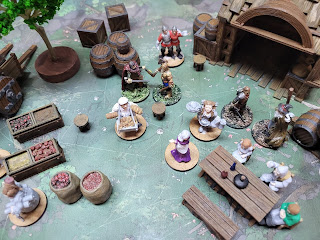
Chapter 17 - Team Bramblehold - Of Ashen, Teryn, Bolo Berrytoe and Penny Cottonrush

Autumn’s breath had grown brittle. The leaves no longer fluttered—they fell in sudden spirals, brittle and dry, crunching under boot and paw. The air had a sharpness to it now, a crystalline tension that smelled of bark, stone, and the long hush before snowfall. Even the animals moved differently heavier, slower, their coats thickening with instinct. The whisper-willows, once full and rustling, now stood lean and alert, their branches creaking like old joints in the wind.
The season was shifting, and Peter and Lucia felt it in their bones. It was time to finalise the stocks for winter, time for the hunt.
The sun had barely crested the treeline when Lucia emerged from the cottage, dressed in her frost-hued cloak and leaf-bound leather. Her breath misted before her, silver and curling. Her bow was strung tight across her shoulder, its carved limbs glittering faintly with frost. A quiver of deep-fletched arrows rested at her back, and a pair of slender bone-knives were sheathed against her thighs. Her bedroll was tightly wound and strapped to her pack, along with hard bread, dried fruit, and a flask of starleaf tea.
Peter stood by the porch, cradling a mug of steaming spruce-needle broth, watching her check her gear with quiet precision.
“You’ve packed enough to feed a regiment,” he said, voice warm despite the chill.
Lucia glanced up, a smile playing on her lips. “You know me. I like to be ready.”
“I know you. You like to bring back more than meat.” He sipped from his mug. “Last time, I counted six new fungi, a moss that glows, and a nest of suicidal weasels.”
“They weren’t suicidal. They were territorial.” She slung her pack over one shoulder and stepped closer, placing a hand against his chest. “I’ll be three days. Four if the herd’s gone further up the glen.”
Peter nodded, one arm sliding around her waist. “The goats’ll miss you.”
“And the pigs?”
“They’ll just eat your boots if you leave ’em out again.”
She kissed him gently—cold lips, warm heart—and whispered, “Keep the fire warm.”
He held her gaze. “Always.”
And then she was gone, slipping between brambles and bare birch like mist in motion.
Lucia moved through the wild like a wisp—silent, unseen. The trail up the glen narrowed between frost-slicked stones, where hawthorn and elder stood naked of leaves but full of ripe, crimson berries. Far above, the hills wore their first dusting of snow like a breath barely held. Ravens circled, black against pale skies.
She found the tracks by a frozen creek: wide hooves, deeply pressed. A small herd. Deer, maybe two does and a stag, passing through the glen’s upper hollow on their slow descent toward the pine valleys. She crouched, pressing her fingers to the cold print, whispering a soft phrase in Elthiriel—the ancient tongue of the forest hunters.
“Guide my arrow. Forgive the taking.”
That night, she camped beneath a rocky overhang, her small fire veiled with moss to dim its light. The stars were sharp as blades. Somewhere in the distance, wolves howled—low, warning, ancient. Lucia drew her cloak close and listened to the land breathe.
Back at Bramblehold, Peter had no time to be still.
He started with the wood pile—splitting dry rounds of alder and pine, stacking them under the eaves in neat rows. His axe rang out in the still air, rhythmic as a heartbeat. He paused only to drink from a gourd of cider and stretch his aching back.
The pigs were loosed into the woods soon after, snorting happily as they rooted through fallen leaves and oak acorns, crunching like small stones beneath their hooves. The goats followed close behind, bleating contentedly and rubbing their sides against trunks for warmth. Peter smiled to himself.
“Eat well, you greedy things. You’re sleeping in the barn tonight, like it or not.”
In the hedgerows, he gathered hawthorn berries by the basketful, crimson and sharp-sweet. These he spread to dry for tea, tinctures, and fodder. The rabbits and quail would need extra through the winter moons.
By midday, he checked his local traps and snares—thin loops of cord strung beneath brush and near hollow logs. A brace of squirrels and one lean hare. He whispered thanks for each life taken, as Rusk had taught him.
In the quietest part of the afternoon, as clouds thickened like breath on glass, Peter walked the perimeter of the homestead. The whisper-willows stirred faintly, though there was no breeze. A subtle warning. He made a note to scatter ash lines near the back trail—something moved there in the nights now. He'd wait for Lucia before deciding what to do.
That evening, alone by the hearth, Peter fed the fire with split alder, and its golden glow spilled across the hearth room. He sat in his heavy chair, working a new snare loop between his hands. A pot of stew—rabbit and root—bubbled on the hook, its aroma thick and herbal.
He looked to Lucia’s chair, long-limbed and elegantly carved. Her reed flute rested on the low shelf nearby. He picked it up, turning it over in his hand, feeling the slight warmth it still held from the last time she played it.
“You’ll bring something back,” he said aloud, to no one. “You always do.”
The Moonseed Hearthstone shimmered faintly, casting silver threads through the shadows. Outside, a wind rose in the trees—long and low, like something calling from far away.
And in the glen above, beneath an ice-touched sky, Lucia lay beneath her cloak, bow within arm’s reach, her dreams filled with antlered shapes slipping between ancient trees.
And the forest, old and watching, held them both.
The wind had taken on a sharper bite. Winter crept in with each breath of air, every silvered branch and frost-hardened footprint. Trees now stood skeletal in their silence. Bramblehold’s stone hearth glowed often and long—and with Lucia away, Peter found himself tending it not just for warmth, but for memory.
They would share it again soon. With elderberry wine, if the harvest went well.
Peter rose before dawn, the frost glinting on the porch like powdered glass. He wore his thickest wool shirt, a leather jerkin lined with thistle-fluff, and his pine-cracked gloves. Slung over his back was a hand-woven satchel, and hanging from his belt, a small, curved sickle for gathering fruit.
The elder trees grew farther east, where the slope dipped toward the mossy shale beds. Their berries clung like tiny garnet beads to blackened stems, clustered beneath drying fans of leaves. Peter picked carefully, humming an old tune beneath his breath, filling his satchel by handfuls.
“Lucia’s gonna want cloves in the next batch,” he muttered, eyes scanning the nearby underbrush. “And that little cinnamon stick she hides from me.”
He smiled softly, brushing frost from a branch. He could already picture her sitting beside the fire, wrapped in a wool cloak, cupping a mug of steaming glühwein between elegant fingers.
“Worth the work,” he said aloud.
It was while picking near the base of a hollowed-out elm that Peter first saw the dog.
It stood just at the treeline, ears perked, one paw lifted—watching him. It was no mere stray: tall as a young wolf, with thick winter fur the colour of smoke and ice, one blue eye and one golden. Its muzzle was grey-dappled and regal. Its shape suggested husky blood, but leaner, wilder—something unclaimed by hearth or collar.
Peter froze.
“You’re a bold one,” he said, gently lowering his sack.

The dog didn’t move.
He reached into his pocket and pulled a strip of dried rabbit from his morning pouch. “Hungry?”
Still no movement.
He tossed it gently. The dog waited until Peter looked away, then crept forward and snatched it, retreating instantly.
“So, we’re playing that game, are we?”
This ritual repeated over three days. Each morning, Peter returned to the grove, pretending not to look. The hound always appeared. By the fourth day, it let him sit within twenty paces.
He spoke softly while gathering, telling it stories—of the firelit nights, of Lucia’s laughter, of the time a goat had chased a bandit off the porch.
“I’m going to call you Ashen,” he said one day, after the hound trotted beside him unbidden.
“Because you’ve got winter in your coat and smoke in your eyes.”
The hound didn’t respond—but didn’t run either.
That evening, Ashen sat just outside the goat pen as Peter chopped wood. By the next night, he curled up under the porch.
Ashen was born in the shadowed fringe of the Old Barrowpine, deep within the untamed woods east of Bramblehold—land where few men tread and even fewer return. His mother, a silver-coated husky once owned by a border ranger, had fled into the wild during a brutal storm. His father was never seen, though the wolf-blood ran deep in Ashen’s bones.
He grew up feral beneath the whispering branches—half dog, half shadow, belonging to neither man nor beast. The pack that raised him scattered during the Scorchwind Year, when fires devoured the northern thickets. Ashen survived alone, lean and watchful, feeding on snow hares and scenting danger long before it arrived.
One frost-dusted morning as the trees turned to gold, Ashen followed the scent of elderberries and cooking smoke through a hollowed elm trail. There he saw him: Peter Anderton, bent at the waist, harvesting fruit, singing in a voice rough as bark. Ashen kept his distance, curious but cautious. The man had the smell of forest and fire. Not a hunter, not a bandit—something else. Something steady.
The first time Peter spoke to him, Ashen didn’t run.
The second time, he stayed long enough to catch the strip of dried meat tossed in the snow.
By the fifth day, Peter had stopped pretending not to care. He would speak to the dog as he worked:
“You’ve got your ghosts. I’ve got mine. Maybe we don’t have to carry them alone.”
Ashen came to sleep under the porch that night, close enough to feel the warmth of the hearth through the stone. From then on, he became Peter’s silent shadow in the woods, helping with traps, warning of intruders, and curling beside the fire when the winds howled outside Bramblehold’s walls.
Though no collar ever touched his neck, and no leash bound him, Ashen chose his home—and Peter chose him back.
Together, they became the kind of companions only the wild could forge: wordless, fierce, and true.
Lucia had tracked the herd for two days, her boots moving soundlessly across crusted grass and shallow snow. She knew the signs: fresh droppings, broken bracken, tree bark scored by antlers. She moved like a wraith beneath the pines, her breath slow and invisible.
At last, she found them—a herd of seven deer, clustered in a sunlit hollow where the wind was gentler. A young stag with five-pronged antlers, two does, and their offspring.
She crouched low, eyes narrowed. The stag was strong, healthy, proud—but not yet old. She admired him for a moment longer than she should have.
Then her eyes drifted to a yearling buck, trailing behind, limping slightly. Its coat was speckled with patches of white. Not sick, but vulnerable. It would not survive a hard winter.
Lucia drew an arrow, lifted her bow, and slowed her breath. “Peace,” she whispered in Elthiriel.
And then—crack.
A sudden rustle of brush. The herd bolted in a flurry of hooves and panicked snorts. Her shot never loosed.
Lucia turned instantly, arrow nocked. “Show yourself.”
From behind the snow-brushed underbrush stepped an elf in ash-grey leathers, cloak leaf-patterned, spear held loosely at his side.
His hair was dark and braided in the style of the Aiel Wildguard, his skin wind-worn, eyes like polished jet.
“You hunt alone,” he said in accented Elthiriel.
Lucia lowered her bow slightly. “So did you. Poorly.”
The stranger inclined his head. “I disturbed your quarry. My fault.”
She studied him for a long breath. “Who are you?”
“I am Teryn of the Ember Path, Aiel hunter. I track the corruption west of the glen. But… I also hunger.” A glimmer of humour passed over his features.
Lucia relaxed—slightly.
“Then let’s earn it,” she said. “Together.”
As the sun fell behind the high ridge, Lucia and Teryn moved as shadows through the twilight. They spoke little—communication passed through gesture, glance, shared rhythm. Where he was a silent runner, she was a breeze through branches. When she paused to listen to the wind, he read the shape of hooves in snow.
By moonrise, they had found the herd again. This time, they moved in a pincer pattern. Lucia crouched behind a copse of frost-bitten hazel. Teryn moved to flank, spear ready.
The yearling buck stood again at the rear, distracted, exposed.
Lucia drew her breath, steady and sure, her arrow loosed with a whisper like wind over silk.
It struck true—swift, merciful.
The buck fell gently to the frost-covered moss. The other deer scattered like ghosts, but the woods were silent again.

Teryn approached and bowed slightly. “You are well-named, forest-sister.”
Lucia knelt beside the body and murmured thanks. “He will keep two families warm.”
They skinned and quartered the animal swiftly, wrapped in oilcloth and stored in Lucia’s sled. As the stars bloomed overhead, the two hunters sat near a small flame, sharing bark tea and roasted root. Teryn offered a smoked fish from his own stores.
Lucia looked at him across the fire.
“You travel alone.”
He nodded. “But not always. Roads sometimes… converge.”
She smiled faintly, raising her tin cup. “To shared paths, then.”
And he replied in kind, “Until the wind changes.”
The first snowfall came lightly—just a breath of white upon the glen, enough to soften the edges of stone and stump. It clung in gentle drifts to pine branches and gathered like quiet secrets in the hollows of old roots. Lucia and Teryn moved steadily through it, side by side, dragging their sleds over crisp ground, antlers rising like crooked crowns from beneath the wrapped hides.
Each sled bore a deer—cleanly slain, carefully bound.
The snow crunched beneath their boots as they walked.
“I would not have expected you to take the shot,” Teryn said after a stretch of quiet travel.
Lucia adjusted her grip on the sled’s rope and gave a faint smile. “You mean because I hesitated?”
He shrugged. “Because you honoured him first.”
“I always do.”
She paused at a ridge where a frost-covered log offered a view of the winding river below. Mist coiled like silver ribbon through the trees. She turned to him.
“You hunt for survival,” she said, “but I hunt with memory. This land is… old. The deer know it better than we do. Taking one—it should mean something.”
Teryn studied her for a moment. Then he nodded. “Your words carry weight. Like snow on bark.”
Lucia gave a rare, amused laugh. “High praise from an Ember Path.”
They walked on, less formally than before. Their silences became companionable, filled with the sounds of sleds gliding, ravens calling, and the distant creak of frozen trees. They spoke of strange things found in the forest: buried runes, songbirds that mimicked crying children, a tree that bled silver sap. At some point, they stopped addressing each other with titles. It was simply Teryn and Lucia now.
By dusk, smoke curled once again above Bramblehold’s stone chimney, and the low, lantern-lit cottage sat like a warm thought against the winter-blued wood.
Lucia’s eyes lit when she saw it.
“There,” she said softly. “Home.”
Teryn halted beside her. His expression was hard to read—wistful, perhaps. Or cautious.
“You built this place?”
“We did,” she replied. “Stone by stone. Root by root.”
They stepped closer—and that’s when they saw them:
Peter, kneeling by the goat pen, repairing the fence post with a mallet and wedge. And beside him, sitting alert but relaxed, was a great grey hound, one blue eye and one gold, watching the woods like it owned them.
Lucia’s brow lifted. “Well,” she murmured, “he made a friend.”
Peter looked up at the sound of approaching sleds and stood, wiping his hands on his trousers. Ashen rose and padded forward silently, fur bristling.
Lucia raised a hand. “It’s us, Ashen.”
The hound sniffed the air and then trotted up, tail flicking once. Lucia knelt, scratching behind his ears. “You're larger than I imagined,” she murmured.
Peter approached next, smiling. “Two deer? You’ve been busy.”
Lucia rose and embraced him with one arm. “You kept the fire going?”
“Always.”
He nodded toward Teryn, who stood at respectful distance, watching the hound.
“This is Teryn,” Lucia said. “He helped with the hunt. An Aiel. He’s tracking something darker than hunger.”
Peter gave the elf a long look, then offered a hand. “You’re welcome here, if you can chop wood and don’t scare goats.”
Teryn took the hand with a firm grip. “I can do both. I also stir stew like a bard and sew my own boots.”
Peter raised an eyebrow. “Huh. Might keep you around.”
That night, around the hearth, they shared the first cuts of venison with turnips and herbs, spiced with early-clove and elderberry glaze. Ashen lay by the fire, ears twitching but calm. Teryn sat cross-legged, his spear resting against the wall beside Lucia’s bow.
The Moonseed Hearthstone pulsed gently with light, and the silver runes in the floor flickered with warmth. Outside, snow had begun to fall again.
Teryn sipped from a carved wooden cup. “This place… it is protected. Rooted. Rare.”
Lucia nodded. “And winter is long.”
Peter spoke, voice steady. “We’ve room in the loft. If you’re staying, you’ll earn your keep. Chop, hunt, watch the tree line.”

Lucia offered a soft smile. “Then you’ll overwinter at Bramblehold.”
Ashen lifted his head, gave a soft whuff, and laid it back down again.
Somewhere in the forest beyond, wind curled between branches. But inside the cottage, the fire cracked, the walls held strong, and four hearts—two human, one elf, one wild—beat in quiet accord.
The wind had changed. It came now from the north, sharp and sudden, carrying with it the breath of frost and the bite of coming snow.
Bramblehold stood firm in its wooded glade, warm smoke rising from the chimney, goats huddled near the pen, and the garden tucked beneath frost-withered straw. The homestead pulsed with quiet, purposeful energy as winter’s fingers curled closer.
Peter had stripped and strung lengths of venison from the beam outside the shed, the meat now drying into rich, dark biltong, rubbed with juniper ash and pepperleaf. He checked it daily, brushing snow from the hooks.
“Too moist and it’ll spoil,” he muttered to himself, slicing a thin strip to taste.
Lucia was further afield, moving lightly through the trees, goats and pigs ambling behind her. She called to them in melodic tones, guiding them to patches of oak where fallen acorns still lay beneath the snow-dusted leaf litter. Her satchel grew heavy with rosehips, hazelnuts, and the last of the winter crabapples.
Teryn had taken to the garden with uncertain hands, pulling up the final hardy carrots and tending the chickens. She wasn’t used to soft work—but her heart was strong and her resolve stronger.
She smiled faintly as Lucia returned that evening, hair dusted in frost.
“You look like a snow druid,” Teryn said.
“And you like a woman who hasn’t milked a goat before,” Lucia replied.
“They bite.”
“They test.”
Their laughter echoed against the stone walls as Ashen stretched and gave a short huff from his spot by the hearth.
Far to the south, deeper into the forest, two halflings—mud-splashed, bundle-laden, and increasingly cold—picked their way along a mossy deer trail.
Bolo Brambletoe was short even for his kind, with a cheerful face and a scarf that trailed three feet behind him. His companion, Penny Cottonrush, had sharper eyes, a bow slung over her shoulder, and a pack nearly her size strapped across her back.
“You said there’d be work and hot pies by now,” Penny muttered.
“I said I’d heard of adventurers! This Kleiner Alter Hof is supposed to be full of ‘em! We just have to find it.”
“You’ve had us walking for three days through goblin-gnawed hollows, Bolo.”
“Well… yes. But I’m still mostly sure it’s north-ish!”
Then they stepped into a clearing—and stopped.
Smoke from a chimney. Neatly stacked firewood. A low, hand-built fence with bleating goats beyond. A stone cottage nestled against the woods like it had grown there.
Bramblehold.
“Do you think they’d chase us off?” Bolo whispered.
“Not if they’re decent folk,” Penny said, narrowing her eyes. “Come on.”
Peter was the first to see them—two shapes at the edge of the snowed track, wary but unarmed.
“Lucia!” he called. “You’ve got new neighbours.”
Lucia stepped out from the porch, bow slung across her back. Teryn followed, curious.
The halflings approached cautiously—until Ashen padded forward, ears perked, eyes glowing like gold and ice.
Bolo froze. “That’s a direwolf, Penny. I know one when I see it.”
“I am not a direwolf,” Lucia said dryly. “He’s called Ashen. And he won’t bite unless you do something foolish.”
“Which you might,” Peter added.
Ashen sniffed once at Penny’s boots, then turned his attention to Bolo’s scarf, tail wagging. He gave a single huff of approval and trotted back to the porch.
“...Well, I suppose we passed?” Penny offered.
That night, the hearth glowed bright with oak and thorn, and two extra stools had been dragged out from the cellar.
Lucia poured tea steeped with dried apple peel and cinnamon bark. Peter passed out bowls of stew—venison, carrot, and sage.
“So what brings you two this deep into the woods?” Teryn asked, elbows on knees.
“Work,” said Penny. “A story, maybe. We’re not adventurers. Yet.”
“But we’re good with animals,” Bolo added. “I can mend fences, and Penny here’s a fair hand with poultry.”
“We’ll earn our keep,” Penny promised. “Just… maybe a roof for the winter?”
Lucia and Peter exchanged glances. Teryn shrugged. Ashen made a deep noise—somewhere between a growl and a sigh—and lay back down.
“We’ve room in the root loft,” Peter said finally.
“It’s dry, warm, and smells only slightly of turnip,” Lucia added.
“You’ll be mucking goat pens in the morning,” Teryn warned.
“A bed and work?” Bolo grinned. “We’ve stumbled into halfling heaven.”
Penny Cottonrush and Bolo Berrytoe both hail from the Riverland Dales, a lush halfling region nestled between winding streams, ancient orchard groves, and sleepy hill-hamlets. Though they weren’t born in the same village, their paths often crossed at harvest fairs, baking contests, and shared defence during goblin raids.
Penny was raised in a clan known for magical cookery and ancient halfling herb craft. Gifted with a keen nose for ingredients both mundane and mystical, she became known as the Kitchen Witch of Tanglebank. But when blight began spreading across the fields and livestock began vanishing, Penny sought answers in the wider world.
Bolo, on the other hand, was a scout and runner—a bright-eyed forager who knew every rabbit trail and fox path in the region. When his family’s burrow was swallowed by a sinkhole during a sudden tremor, Bolo took to the road, hoping to find a new safe haven—and new stew pots to raid.
When a chance meeting in the smokehouse ruins of Elderbell reunited them during a dire time, the pair agreed to travel together. Penny would cook, Bolo would scout, and between the two of them, they'd find a place to call home.
Their wandering brought them to Bramblehold, a remote homestead rumoured to be cursed—but warm, welcoming, and strangely full of potential. They helped rebuild the old lodge, enchanted its kitchen hearth, and joined a growing group of adventurers defending it from darkness.
Together, Penny and Bolo are on a shared quest to restore forgotten halfling traditions and recipes tied to ancient magic and uncover the source of the Riverland Blight that ruined their homeland.
So Bramblehold grew by two. Days passed, and snow thickened on the rooftops. The goats grew fat on acorns and cud. Chickens huddled together in straw. The wind howled beyond the trees, but within the stone walls, there was life, and laughter, and flame.
Ashen patrolled the edge of the clearing.
Penny repaired the henhouse gate.
Bolo tried to make cider and burned a pot—earning a lecture and a second chance.
And sometimes, after supper, they all sat together around the fire. Lucia would tell tales of Starfen Grove, Peter would mend fletchings, Teryn would polish her blade, and Bolo would try (and fail) to convince Ashen to chase a stick.
For a while, at least, the world’s dangers were far off. Winter had come. But so had company.
And Bramblehold stood strong. The winter nights deepened like ink spilled across the sky, stretching longer with each passing dusk. Snow lay thick upon the rooftops and draped the woods in a frozen hush. No footprints marked the old trade road anymore—just the wild trails of deer, foxes, and the occasional sweeping wingmark of an owl.
Within Bramblehold, the world narrowed to hearthlight, shared labor, and the slow rhythm of winter routines. Under Peter’s quiet, dependable direction, the household moved like a well-tuned bowstring.

“Gotta fix that hinge before the cold gets inside and rots the frame,” he’d mutter to himself, standing on an upturned bucket as he hammered in new slats for the goat pen.
Peter often found him in strange positions: wedged under the workbench, elbows deep in a feed chute, or climbing onto the porch roof “to check the chimney draught.”
“You’ve taken over my toolbox,” Peter grunted one morning, watching Bolo drag it through the snow again.
“Aye, but I’ve improved it!” Bolo grinned, flipping it open to reveal new compartments carved from scrap wood. “Sorted the nails by length and everything. You had roofing screws with your trap-wire, man!”
Peter stared at him for a long moment. “You’re mad. But useful.”
Evenings found Bolo stretched in his fireside chair, pipe glowing like a tiny hearth of its own. He puffed in silence until the room was thick with rosemary-scented smoke, then turned to Teryn with a sly grin.
“So, what’s this Ember Path again? Some kind of elven poetry club with swords?”
Teryn, who had been carving patterns into a length of bone, arched a brow. “It’s an ancient discipline of purpose, spirit, and survival. Only those who walk through shadow and emerge unchanged may claim it.”
“That sounds exactly like my Aunt Maud’s second wedding,” Bolo quipped.
“Did she duel a specter in a sacred glade?”
“Worse. She married one.”
The laughter that followed rolled through the rafters like warm cider down a throat.
Penny Cottonrush never officially asked to be the cook. She simply claimed the kitchen like a conqueror with an apron, and no one dared argue—not after tasting her rosemary venison stew and the crusted apple tarts she produced in such alarming quantities.
Even Ashen began curling up beside the hearth earlier each day, as if drawn by the scent alone.
“You’re baking again?” Lucia asked one afternoon, watching Penny knead dough with confident elbows.
“There’s a chill coming. Bread helps,” Penny replied with a shrug. “Besides, if I stop, you lot might resort to eating turnips raw again.”
Lucia shuddered. “Don’t say that. Not in this house.”

“By the thorns and bramble vine,
Keep your cider, I’ll take wine!
Taters fried and onions brown,
That’s what keeps my worries down!”
“Stop it,” Peter groaned one morning, grinning as he caught himself singing it aloud while checking the smokehouse.
Though a warrior by trade and spirit, Teryn surprised herself in Bramblehold. Beneath her leather bracers and wild-knotted braids, there was something else—an echo of her upbringing among the grove-tenders of Vaelorith.
She planted winter onions and tended the rosemary beds that clung bravely to the cold earth. She strung drying herbs above the door, marked the old apple tree with a knot of crimson thread for the spring spirits.
One morning, as she trimmed frost from the kale beds, Peter leaned on the gate and observed her.
“Didn’t take you for a gardener.”
Teryn smirked. “Didn’t take you for a philosopher. Yet here we are.”
Lucia was tireless that season. She wove bark ropes to hang tools, carved new shelves into the alcove, and finally built the vine trellis over the eastern porch she’d been planning since summer.
She re-etched the sigil tiles on the hearth and laid new charms of warmth and warding along the window ledges.
Yet Peter noticed it most in the evenings, when her gaze turned toward the window, watching the snow drift down through the branches. Her stories of Starfen Grove grew longer, tinged with starlight and memory.
“There was a silver tree,” she said one night, eyes far away. “We called it Moonroot. It only flowered when a life began or ended beneath it.”
Peter said nothing. He only watched her from across the firelight, a knot of quiet worry forming behind his ribs.
“You miss it,” he said softly.
Lucia turned her head. “Sometimes. But not enough to leave. Not yet.”
That not yet settled into the air like snow on branch. It didn’t fall. But it stayed.
And so the days passed. Snow thickened on the beams. The chickens huddled in straw. The goats nuzzled against Ashen’s flank when he dozed beside the coop. The fire never faltered.
Together they worked. Together they feasted. And in the heart of the cold, they belonged.
Just beyond the frozen tree line, the world turned onward—but within Bramblehold, time slowed to the rhythm of fire-crackle and laughter.
And winter—fierce, pale, and star-edged—was not so fearsome after all.